It feels like I spend quite a bit of time writing about rest. I think that’s a good thing because most highly motivated athletes are bad at resting. I like balance in my life, so now it’s time to talk about building your Functional Reserve Capacity (FRC).
FRC = The amount of work you can perform above FTP, measured in kilojoules.

This is the opposite of rest. FRC is commonly referred to as the size of your matchbook. Attacking burns a match. Surging up a steep climb burns a match. Really, any effort above FTP burns a match.
You can burn one very quickly by going way over FTP or slowly by riding just over it. Think of an all-out 30-second sprint as you lunge for the finish line in a criterium as one of the fastest ways to burn through your matchbook. The slowest way is to ride just slightly over FTP.
When the pace drops below FTP, some of that capacity can recover, effectively putting a few matches back in the book.
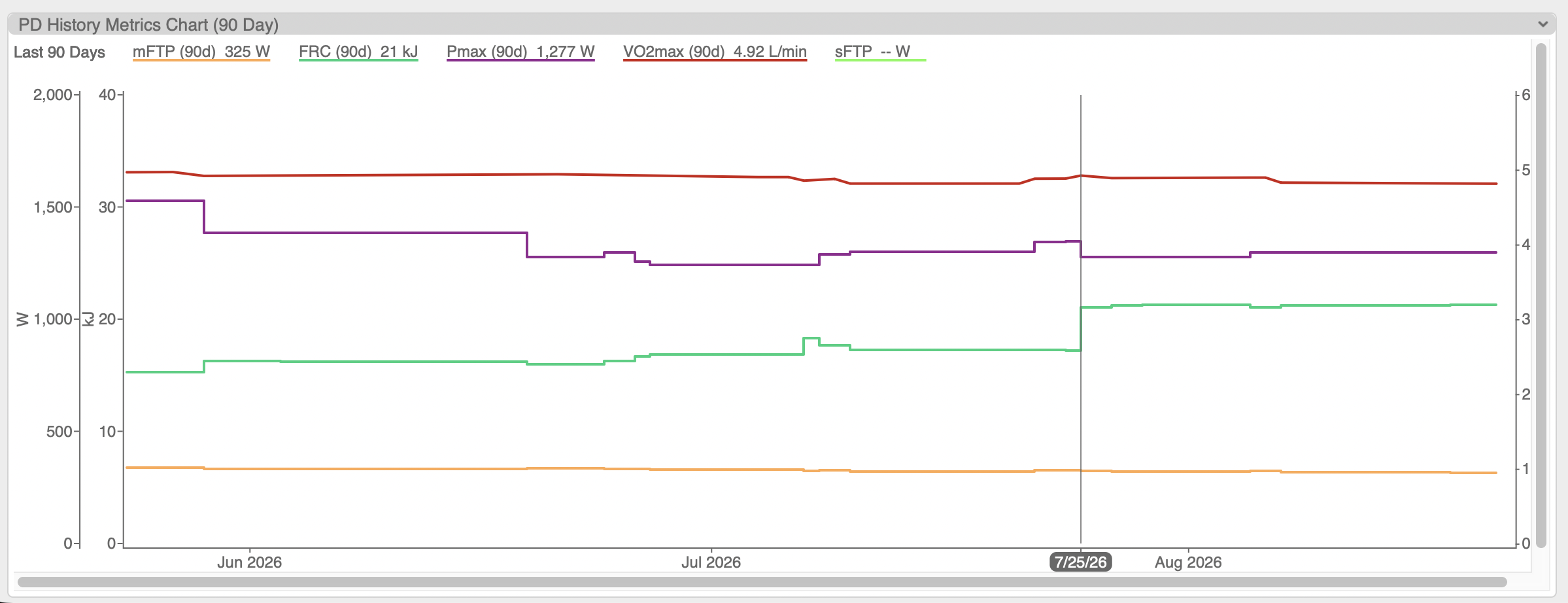
WKO’s individualized cycling levels show how efforts above FTP move into FRC-related ranges. The farther power rises above FTP, the shorter the duration you can sustain it.
I learn through examples, so let’s walk through a couple of real-world race scenarios to see why this matters.
One quick note before we do: I’m intentionally simplifying the math in these examples to make the concept easier to understand. Actual FRC depletion and recovery are modeled more dynamically than simply subtracting every joule above FTP and adding it back below FTP.
Gravel Athlete 1: FTP 250 W / FRC 10 kJ
The first 30 minutes of the race are fairly steady, with only a couple of very short spikes above FTP. Those efforts are so brief that they barely touch the athlete’s FRC, so they still have essentially all 10 kJ available when the race reaches its first major selection point.
At the 30-minute mark, the course pitches upward into a steep two-minute climb. The front group attacks, forcing this rider to average 325 watts just to stay in contact. Since that’s 75 watts above FTP, the rider burns through 9 kJ of FRC during the climb.
They crest the hill with just 1 kJ left in the tank. They’ve survived the climb, but they’ve burned almost every match they had.
The road tips downhill for about 30 seconds, and the pace eases to roughly 175 watts. Riding below FTP allows the athlete to recover a small amount of FRC, bringing them back up to about 3.25 kJ. It feels like a chance to catch their breath, but the recovery is nowhere near enough to refill the matchbook.
As soon as the descent ends, two riders launch an attack. To stay with them, the athlete has to sprint at 600 watts for 10 seconds. That surge requires 3.5 kJ of FRC, but they only have 3.25 kJ available.
About 9 seconds into the sprint, they’ve burned their final match.
Even though the sprint is almost over, the damage is done. The group settles in at 280 watts on the flat, but that’s still above the rider’s FTP. With their FRC completely depleted, they no longer have the ability to produce the extra power needed to stay in the draft. The gap opens almost immediately, and within seconds they’re off the back of the lead group.
The rider didn’t get dropped because of the final attack. They got dropped because the two-minute climb burned almost every match they had, leaving them with nothing when the race demanded one more big effort.
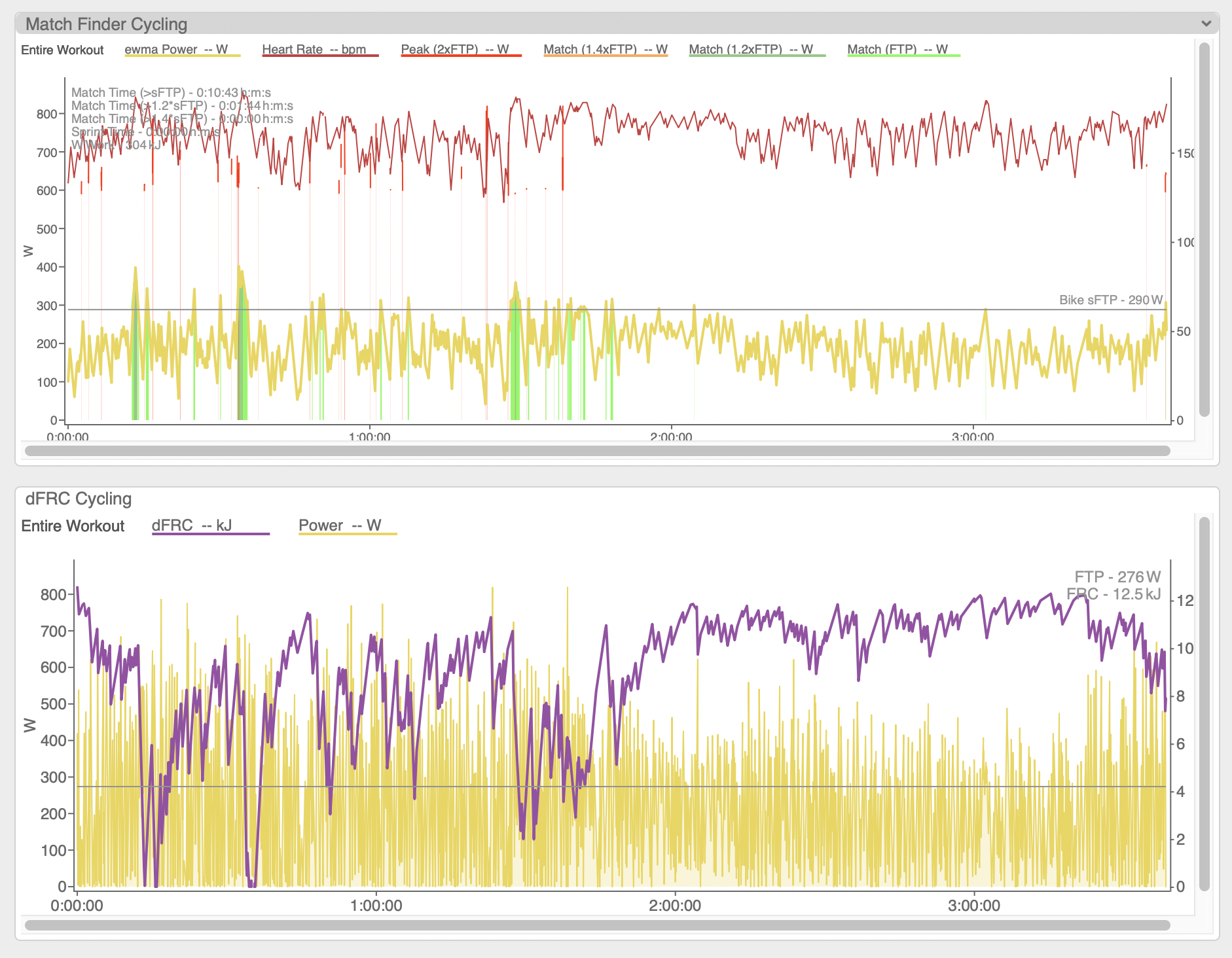
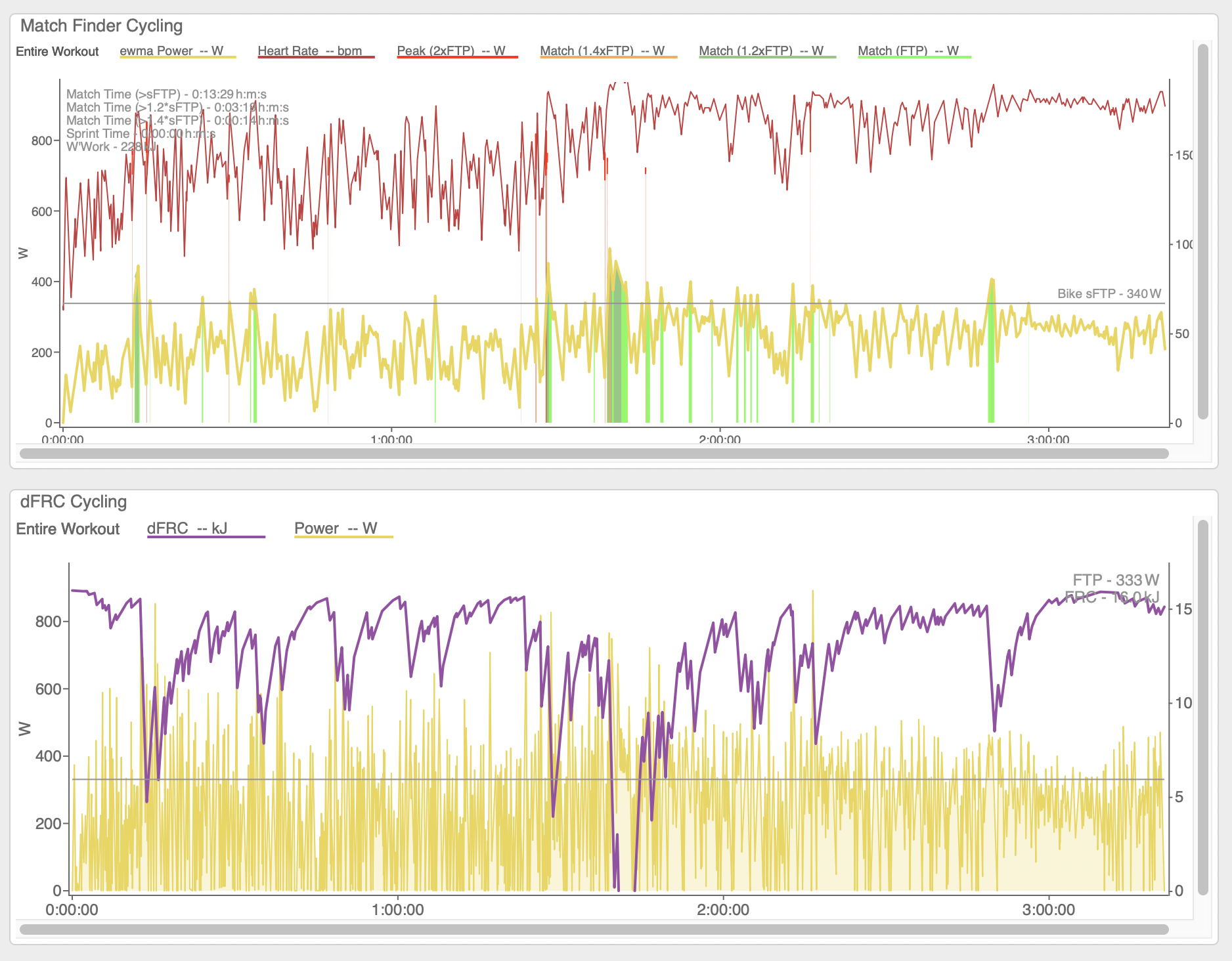
A race-like example in WKO. The purple dFRC line falls as hard efforts burn matches and rises when the rider gets enough recovery. Repeated surges can leave very little reserve for the next move.
You can see early where the athlete burnt all their matches and lost contact with the front group.
Gravel Athlete 2: FTP 250 W / FRC 17 kJ
Now let’s look at the exact same race with an athlete of the same weight and the same 250-watt FTP, but with a much larger 17 kJ FRC.
The first 30 minutes play out exactly the same. The pace is steady, the short surges are insignificant, and the rider arrives at the base of the climb with essentially their full 17 kJ available.
At the 30-minute mark, the group hits the same two-minute climb. Holding the lead group still requires 325 watts, which burns 9 kJ of FRC. Unlike the first athlete, however, they crest the climb with 8 kJ still in reserve.
That’s a huge difference.
Not only do they have far more capacity remaining, they’re also much less likely to feel the sensation that they’re approaching their limit. They know the effort was hard, but they’re not yet in survival mode.
The 30-second descent at 175 watts allows them to recover another 2.25 kJ, bringing their available FRC back up to roughly 10.25 kJ.
Then the two riders launch the same attack.
Following it requires 600 watts for 10 seconds, costing 3.5 kJ of FRC. That still leaves the rider with approximately 6.75 kJ remaining as the pace settles onto the flat.
Now the group begins riding at 280 watts. Since that’s only 30 watts above FTP, the rider is burning FRC at a rate of just 30 joules per second, or 1.8 kJ per minute.
With 6.75 kJ still available, they can continue riding at 280 watts for roughly:
6,750 J ÷ 30 J/s = 225 seconds
225 seconds = 3 minutes 45 seconds
That’s an eternity in bike racing.
In this scenario, Gravel Athlete 2 is clearly going to hang on much longer and make it through the key moments that often define road racing (gravel is just bumpy road racing).
Those decisive moments are usually only five to ten minutes long. If you can survive a hard climb, respond to an attack, and then hold on through another couple of minutes of pain, you’ll often find the pace settles into something much more manageable.
Now, you might also find yourself in a breakaway with someone who has a 400-watt FTP, and then you’re probably in trouble no matter how high your FRC is. But that’s another topic for another article, and adding that variable here only makes this example more complicated than it needs to be.
The main thing I want you to take away is this: building your FRC, or more colloquially, increasing the size of your matchbook, improves your ability to handle the moments that decide races.
FTP is still incredibly important, and aerobic development should remain a primary focus, but neglecting FRC training is a common mistake.
Same race, but this athlete was able to stay with the front group. You can see where his FRC was totally depleted halfway through as they hit a big climb. He lost contact with the front few riders, but was able to still finish in the top of his category.
How to Build It
The nice thing about FRC training is that it’s usually very potent. Most athletes respond quickly.
Putting that into real-world terms, four to six dedicated sessions spread across four to six weeks, alongside your normal aerobic training and maybe a couple of hard group rides or races, will usually produce noticeable improvements.
The exact dose should always be individualized, and nobody can promise a specific response. But if you’ve spent the last 12 to 16 weeks smashing long rides and FTP-focused training only to get dropped at the first series of attacks or steep climbs, I’d argue you probably need some FRC work before your next race far more than you need another month of threshold intervals.
What Do These Sessions Look Like?
They’re hard.
If you use WKO, you can get very specific and build sessions like 6 × 37 seconds at 456-473 watts with 90 seconds recovery. I often use those guidelines, but I’ll usually simplify the workout to something like 6 × 35 seconds at 455-475 watts, or even a slightly wider power range if I don’t have a very accurate 30-day power-duration curve to work from.
I generally think about three different types of FRC workouts.
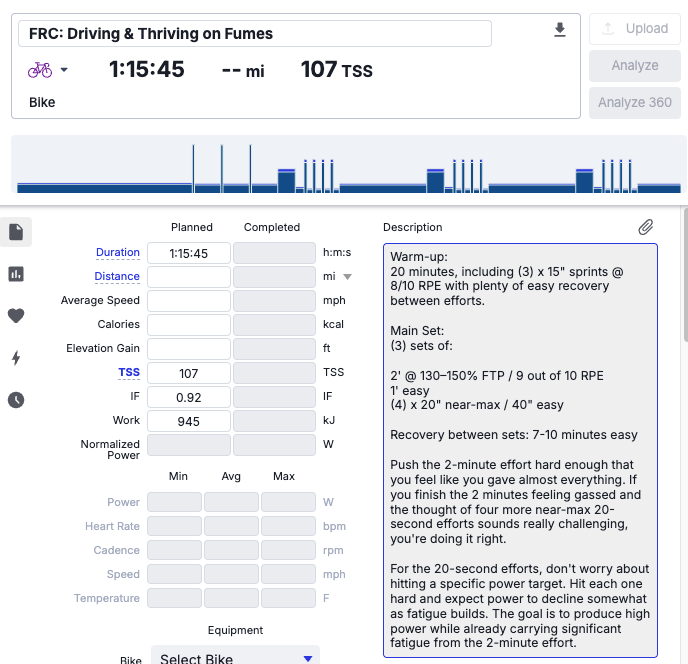
This is the above training session after an athlete completed it. You can see how this session purposefully replicated the demands of really hard race moments.
Longer Power Repeats (Extensive Focus)
Longer efforts of one to two minutes at roughly 90% of maximum effort with generous recovery, usually two to seven minutes.
Max Efforts (Intensive Focus)
Shorter intervals of roughly 20 to 45 seconds at maximum intensity, again with long recoveries of two to seven minutes (sometimes much longer).
Repeatability
Very hard but repeatable efforts with shorter recoveries that continue until you die (these are fun).
A structured FRC session in WKO. Repeated hard efforts drive dFRC down, while the longer recoveries allow it to rebuild before the next repetition.
Your training data and racing demands should guide which type deserves the most attention.
If you’re struggling to produce big power and respond to huge attacks in a criterium, spend more time with the max-effort work.
If you’re struggling to hold the wheel on steep gravel climbs lasting one to two minutes, emphasize the longer power repeats.
If cyclocross has you begging for mercy after countless accelerations, focus on repeatability.
All three put a substantial demand on FRC, but the type of work should reflect what you’re trying to improve.
The important thing to remember is that these workouts are incredibly effective, but they’re also expensive in terms of recovery. Balance them carefully within your training plan, and avoid making them the primary focus for too long.
The benefit of a focused high-intensity block often starts to diminish after several weeks. That said, I would argue your own training data is still the best research you’ll ever have.
Build a plan. Smash the intervals. Review the data each week.
If your interval quality continues improving, which often shows up as less power drop-off throughout the workout and a higher average across all repetitions, keep going.
Once you start feeling excessively fatigued or your numbers plateau or decline, it’s probably time to recover and shift your focus elsewhere.
I rarely recommend doubling down on an FRC block. But if you do, let me know how it goes.
Summary
A bigger matchbook is a valuable weapon to have in your arsenal.
Whether you’re a criterium racer trying to survive repeated attacks or a gravel rider hoping to conquer a hilly course and finish with the lead group, building this part of your engine pays dividends.
You’ll climb harder, respond to more attacks, survive more decisive moments, and just feel like an all-around badass as you jump out of the saddle thinking to yourself,
“Pshhh… I’ve got matches to burn, and I’m gonna burn ’em.”